Le Palaie: our vineyards in Tuscany
Twenty hectares of land, of which fifteen are owned by the Le Palaie estate and five are rented: agricultural land rich in history, tradition, stories and love for the land and for wine. Walking along the rows and touching the plants and grapes always gives great emotions.
The Le Palaie vineyards are the cradle in which various types of wines are produced: from Merlot to Cabernet, Sauvignon and Franc, from Petit Verdot to Sangiovese, from Viognirer to Canaiolo, from Colorino to Malvasia Nera and Bianca, from Colombana to Trebbiano, from Procanico with Canaiolo Bianco and Alicante.
Constant care from autumn to spring
In the month of October, as soon as the harvest is finished, when the days become less hot, in the Le Palaie vineyards the soil begins to be worked, moving it deeply to prepare the seedbed. A miscellany of seeds is used for the preparation, such as beans, field beans, peas, mustards and wheats: this is the green manure of legumes necessary to reintegrate the nutritional elements absorbed by the vine in the summer into the soil.

The pruning of the vines and the subsequent cutting begin towards January. After removal, the vine shoots are composted and contribute to the nourishment of the soil. However, if diseases are found, they are burned.
The next phase is tying: the renewed shoots are bent onto the bank wire and then tied; we start from the lowest part of the scaffolding in order to give shape to the new plant.
With the return of spring, between the end of April and the beginning of May, after the vine has released its buds, we proceed with trimming, also called green pruning. The operator chooses which shoots to carry forward and which to remove. In order to preserve the quality of the plant, between 6 and 8 shoots are generally maintained per plant. Biological treatments take place at the same time.
The rows are never abandoned to their fate. The selection activity continues until the end of June and the beginning of July. In this period the "vine leaves", the leaves and all the other parts that do not bear fruit and that create humidity are removed.
On young vineyards, plants that are no older than ten years old, we continue with topping. The vine, being by nature a climbing plant, requires constant attention and for this reason the tops are cut. On older vineyards, however, we proceed with the hudding: the shoots are taken and twisted onto the highest wire.

Breeding methods
The farmers and winemakers of Le Palaie follow methods linked to tradition, which have remained intact despite the passage of time.
The Guyot is a vine training and pruning system that allows the plant to be modified and improved during its growth phase: it is generally adopted for vineyards intended for the production of wine for commercial use and involves the renewal of the shoot every year, as happens for Sangiovese.
When the plant has buds (spurs) that allow its proliferation, the spurred cordon method is followed, but particular conditions are necessary: the cordons must not exceed one meter in height, they must not have more than two branches and the distance between the rows must be less than one metre. This type of cultivation is preferred for Merlot and Cabernet, for which only the green part is renewed.
The typical Tuscan cultivation system, which involves the creation of the arch with the shoot, was introduced in the 5 hectares of land that the Le Palaie estate has rented. In this plot there are 60 year old plants. The shoot is bent until it takes on the shape of an arch.

Technology
The Le Palaie company uses a system called Decision Support System (Dss), an IT architecture capable of supporting farmers and winemakers in analyzing the decisions to be made, taking into account a series of variables, primarily climatic ones.
The weather stations are particularly useful because the data collected is entered into the system in order to develop a possible intervention scenario.
The lands
The area on which the Le Palaie estate stands is of marine origin. The soil is mainly sandy, with important veins of clay. It is not uncommon to find marine fossils along the vineyards, and it often happens that small shells are discovered. This particular origin gives the soil the salinity that distinguishes Le Palaie wines.

The vines
Vigor is a vine of Croatian origin, then exported to France by the Roman emperor Marcus Aurelius Probus. In 1964 it had almost disappeared: there were just 8 hectares of it in the world. Today, however, it is one of the 10 most cultivated vines in the world, but there are few producers who use it in purity.
Alicante derives from the Colorino Pisano, a grape variety called tintoria because the pulp inside is red. Around the year 1000, during pilgrimages on the Via Francigena, there was the custom of bringing along souvenirs of the journey, and often for this purpose vine plants were chosen, which were then replanted in the pilgrims' lands of origin.
From Colorino, therefore, Alicante, Drainage, Tignanello and Cannonau developed.
Procanico is a Trebbiano which once it reaches maturity becomes pink in colour, and is very fleshy in the mouth: it is the progenitor of the Trebbiano we know today.

Malvasias are very aromatic. The Passito di Colombana is a grape known in the national register of vine varieties as verdea, originating from the territory of Peccioli, in the province of Pisa: it is said that a saint of Irish origin, San Colombano, planted a series of his own vines in the seventeenth century in Peccioli and started its cultivation.
Initially, farmers left Colombana grapes between the rows to eat during working hours. Only after discovering its qualities in winemaking was the harvest started, which usually takes place in the period between mid-October and early November, precisely in correspondence with the feast of San Colombano.
Chianti originates from the areas between Florence and Siena. Originally Chianti was spoken of as a white wine, until 1872 when Baron Bettino Ricasoli, originally from Florence (of which he was also mayor) and second Prime Minister during the Kingdom of Italy after Camillo Benso, Count of Cavour, he developed the recipe for an excellent quality wine, capable of withstanding the competition with the French: 75% Sangiovese wine (Sangiovese, we read in his writings) and the rest from other grapes, both white and red berry.
Following this lead, Tuscan farmers began to plant other varieties in the Sangiovese vineyard. When the Le Palaie estate leased 5 hectares of land, it found promiscuous vineyards. Why not respect history and tradition? Hence the vinification of white and red for Chianti, in honor of Ricasoli's recipe.
Featured products
-
Brusio d'Era
Vendor:Le PalaieRegular price €25,00 EURRegular priceUnit price per -
Vista Vigna
Vendor:Le PalaieRegular price €22,00 EURRegular priceUnit price per -
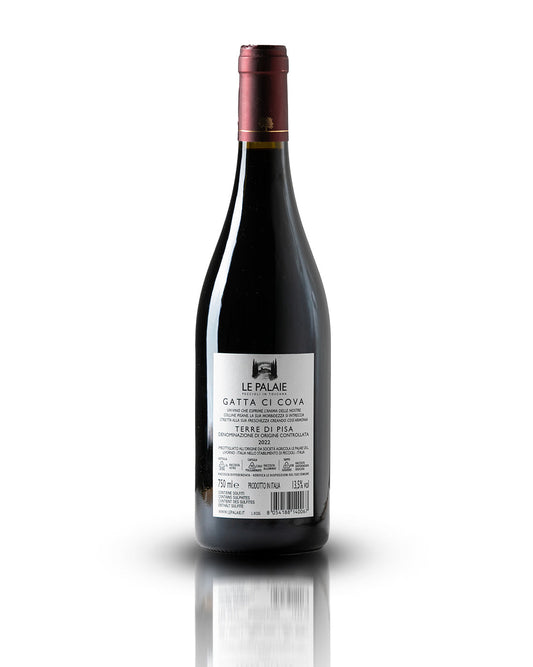
Gatta ci Cova
Vendor:Le PalaieRegular price €15,00 EURRegular priceUnit price per